
%20(1).png)


Hardknott Pass Cycling Guide
Conquer Hardknott Pass cycling, the steepest, most brutal road climb in England.
Direction: West to East: Eskdale to Cockley Beck
Overview
Hardknott Pass is a single-track hill pass between Eskdale and the Duddon Valley and is the steepest tarmac surfaced road in England. No write-up of Lake District climbing is complete without it. Climbed from the Eskdale side (the same direction as the Fred Whitton), it starts hard and barely lets up: a series of brutal ramps and hairpins with gradients touching 30–33% at their steepest, the kind of pitch that has even strong riders zig-zagging or stepping off to walk.
The Details
-
Distance: 2.2km
-
Elevation gain: 298m
-
Average gradient: 13%
-
Maximum gradient: 30 - 33% (hairpins)
-
Surface: Narrow single-track road, well-surfaced but unforgiving in gradient
History & Character
Long before it was a cycling (and driving!) challenge, this was a Roman frontier road known as the Tenth Highway. Cut by the Roman legions in the 2nd century, this engineering masterpiece was designed to link the deepwater military port at Ravenglass (Glannoventa) with the interior fort at Ambleside (Galava). The Romans didn't choose this route because it was easy: they chose it because it was the only viable, direct mountain corridor sitting between the high rock walls of the Furness Fells and the towering Bowfell-Crinkle Crags massif. At the peak of this specific pass sat the fort of Mediobogdum—now known as Hardknott Roman Fort. Up to 500 auxiliary cavalry were stationed here, holding one of the most exposed postings in Roman Britain. The fort's outline is still visible today and is well worth a stop if you've got the legs left to walk up to it after the climb (although I challenge anyone to walk up to it in cleats!). Traces of their original stone engineering are still explicitly visible to the keen-eyed cyclist, running parallel as a rugged footpath just to the north and south of the modern tarmac.
Following the collapse of Roman rule in the 5th century, the high pass entered a dark, isolated era. Arriving Viking settlers gave the pass its modern identity, naming it from the Old Norse words harthr (hard) and knutr (craggy hill): a brutally honest description that still holds true today. By the early Middle Ages, locals renamed the route Waingate ("cart road") or Wainscarth ("cart pass"). In fact, an incredible document from 1138 records a group of Cistercian monks successfully navigating Hardknott Pass with an oxcart!
Throughout the 17th and 18th centuries, the pass evolved into a vital, treacherous link in Cumbria’s historic packhorse network. Because of its remote, lawless nature, the combined Hardknott–Wrynose section of road became famously known as the "Smugglers' Route." Under the pitch-black cover of night, notorious Cumbrian moonshiners like Lanty Slee would drive lines of fell ponies heavily laden with illicit local spirits right over the mountain passes. To evade the excise men, the smugglers bound the horses’ hooves in sacking to muffle the sound of iron shoes on the rock. They traded their illicit moonshine on the coast for high-value foreign contraband like tobacco and rum, sneaking it back inland over these very same ridges.
In the 1880s, the English Lake District Association (a collective of local hoteliers) decided to heavily upgrade the track. They spent vast amounts of money hoping to establish a lucrative horse-and-carriage tourist route over the mountains. By 1891, the project was deemed a commercial failure; the incline proved far too brutal for average carriage horses. However, the newly cleared road began attracting a brand-new breed of adrenaline seekers: early cyclists and pioneer motorists wanting to test their primitive machinery against a slope that maxed out at a legendary 33%.
During the Second World War, the entire area surrounding the pass was requisitioned as a tank training ground. The heavily armoured vehicles completely obliterated what remained of the ancient trackway. After the war, the government chose to repair the wartime damage by laying down a solid tarmac surface, officially creating the direct, sealed motor route between Ambleside and Eskdale for the very first time.
What to Expect
Riding Hardknott Pass from the classic Eskdale side is a visceral experience that tests every limit of a cyclist's physical and mental endurance. It is less of a traditional road climb and more of a battle against gravity. To survive the 2.2-kilometre journey, which averages a punishing 13.5% gradient and scales nearly 300 vertical metres, you have to break the beast down into three distinct, psychological phases:
1. The Rude Awakening
There is absolutely no gentle introduction. The moment you cross the bone-rattling cattle grid at the base, the road throws you straight into a 25% wall. The tree canopy quickly drops away as you twist through sharp S-bends. Your heart rate will instantly redline. The challenge here isn't pacing; it’s simply keeping your front wheel on the ground and preventing your bike from tipping over backward.
2. The Deceptive Middle
After surviving the opening gauntlet, the gradient briefly settles down to a much more manageable 5% to 8% for about half a mile. This section passes right alongside the ancient stones of Hardknott Roman Fort. Do not use this relative flat to gain speed, instead use it to drop your shoulders, force air back into your burning lungs, and to try and recover... Because what lies directly ahead is pure intimidation.
3. The 33% Monster
The final 700 metres are the reason Hardknott is legendary. The road rears up into a terrifying amphitheatre of stacked, almost vertical switchbacks that hit a staggering 33% (1 in 3) gradient. The asphalt here can be rough and broken. If it has rained, your rear tyre will threaten to slip on the wet surface if you stand up on the pedals. You will be forced to wrench on the handlebars and dig into a level of suffering you didn't know you had just to keep moving. Even after the hairpins, the road keeps torturing you in the high teens until you finally hit the summit marker stone.
The Reality of the Terrain
Today, the climb itself narrows to single-track in places, cutting through open, rugged fell side with no tree cover and no real flat sections to recover on. The road surface is quite poor and the gradient just makes everything much harder. This isn't a climb that rewards pacing mistakes: it demands absolute respect from the very first pedal stroke.
Guide's Experience
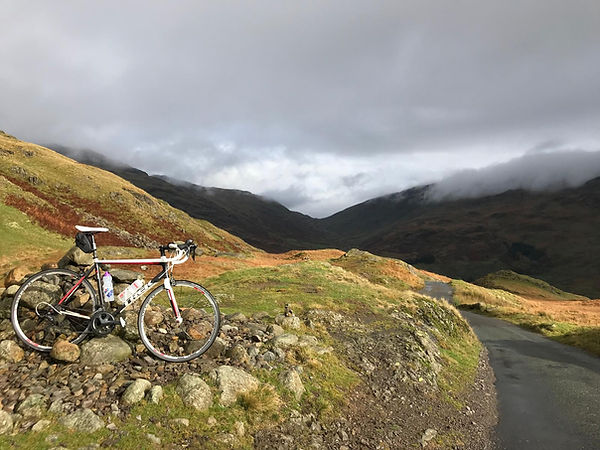
My first encounter with Hardknott Pass was the exact definition of "blissful ignorance" - after all, I'd never ridden anything steeper than 20% before. I turned up my trusty £700 aluminium road bike (see picture at the top) equipped with a 34-28 lowest gear: a ratio that had failed me before. Although it might look reasonable on paper, it felt like a cruel joke at the time!
I distinctly remember being forced out of the saddle almost immediately, my knees screaming as I hauled on the bars. The first half is tough but it's the 33% switchbacks that are what really stay with you. On my first attempt I remember the cold wave of psychological panic set in as I stood up out of the saddle in my bottom gear, grinding at a painfully slow cadence. The thought looping in my mind: “I have absolutely nowhere to go if I don't keep this turning. There is no easier gear, no "get out of the saddle for a brief change in which muscles are feeling the pain", essentially there was nowhere to hide.” If my legs gave up for even half a second, I wasn't just stopping, I was falling sidewards off the tarmac. Survival meant grinding through the agony because clipping out on that incline was simply not an option.
Since that brutal initiation, I’ve been back. I’ve returned on significantly better, lighter bikes boasting much more appropriate, mountain-friendly gear ratios. But here is the truth of Hardknott Pass: it never gets any easier. The extra teeth on the cassette don't tame the mountain, they just change the nature of the fight. With a lighter front end and more torque from the lower gearing, the bike behaves differently under maximum effort. Instead of just grinding, you are actively fighting physics. Pull too hard on the handlebars to generate power, and the front wheel instantly pops off the tarmac, threatening a slow-motion wheelie into the bracken.
Better tech gives you a fighting chance, but Hardknott always demands the same tax. It remains a raw, breathless battle of willpower against gravity where every single pedal stroke has to be earned.
This climb features in our Fred Whitton Epic & Classic tours.

